How Lucknow’s Growing Infrastructure Is Shaping Its Real Estate Future
Lucknow has not expanded overnight. Its growth has happened gradually—one new road, residential sector, commercial complex and transport connection at a time.
People who have lived here for several years can see the difference. Locations once considered too far from the main city are now part of everyday conversations among homebuyers and investors. A salaried professional may consider living closer to Shaheed Path because the office commute is manageable. A business owner may look towards Sultanpur Road or Kanpur Road because access, visibility and future commercial activity matter more than proximity to Hazratganj.
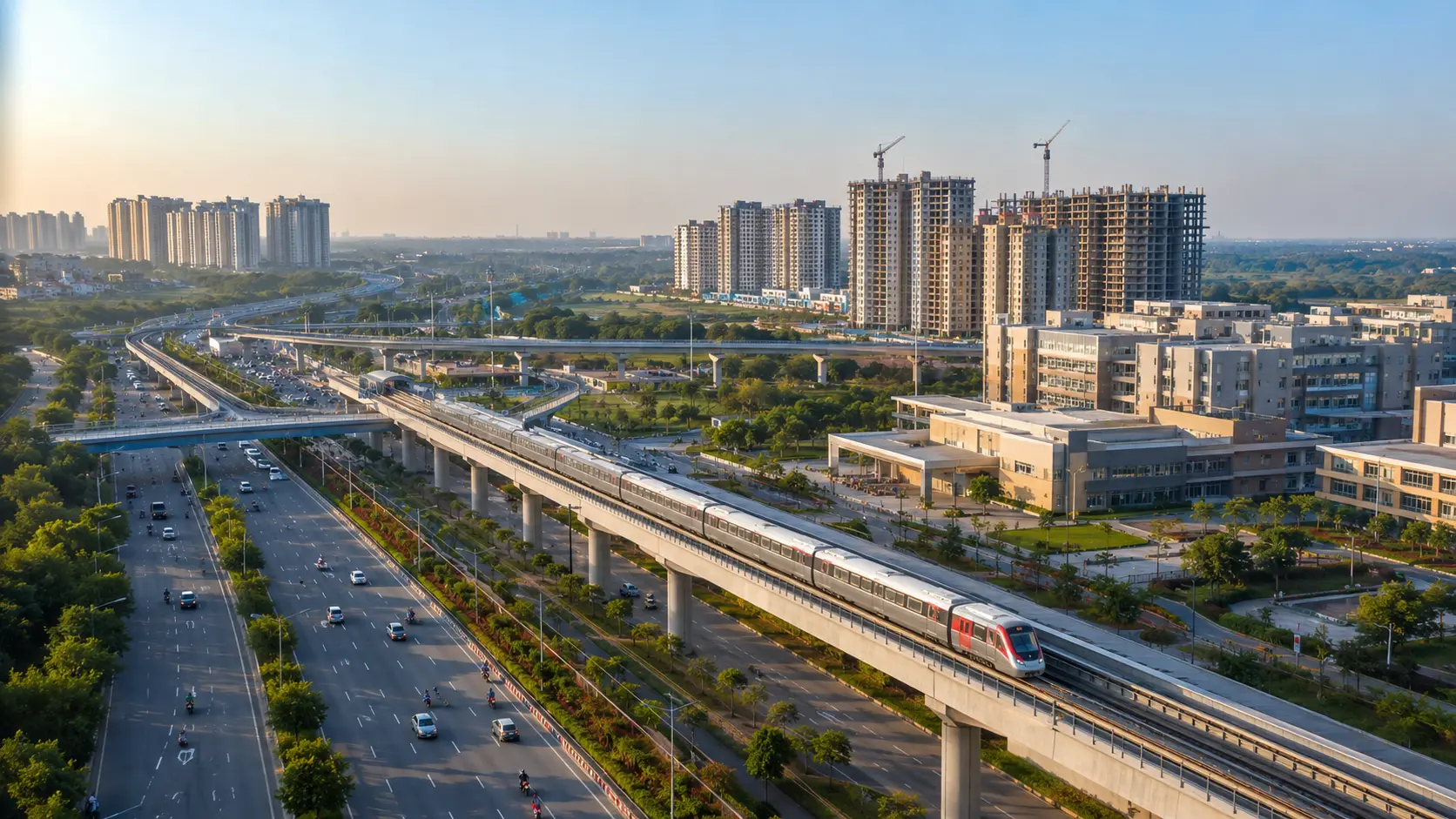
This changing geography is closely connected to Lucknow infrastructure development. Metro connectivity, expressways, the Outer Ring Road, airport expansion and improvements around major corridors are changing how people move through the city.
However, infrastructure does not automatically make every nearby property a good investment. The road may be useful, but the project could still be overpriced. A proposed metro line may improve future connectivity, but its completion could take time. The correct approach is to examine the infrastructure and the property separately—and then understand how they support each other.
Why Lucknow Infrastructure Development Matters in Real Estate
Property demand usually follows convenience. Lucknow infrastructure development can strengthen this convenience by improving access between residential, commercial and public-use locations.
People prefer homes from which they can reach workplaces, schools, hospitals and markets without making daily travel unnecessarily difficult. Businesses look for locations that customers, employees and suppliers can access easily. Retailers require visibility and footfall, while warehouses need dependable road connectivity and space for vehicle movement.
Infrastructure can influence real estate in several ways. The impact of Lucknow infrastructure development can be seen through the following changes:
. Better connectivity can make developing neighbourhoods more practical for families.
. New commercial activity can create demand for offices, shops and rental housing.
. Roads and public transport may expand the area within which people are comfortable commuting.
. Improved regional connectivity can support logistics, hospitality and business travel.
. Public facilities can improve the overall livability of a location.
In this way, Lucknow infrastructure development can influence how people evaluate established and developing locations.
These changes may support Lucknow real estate growth, but infrastructure alone does not guarantee price appreciation. Property values are also influenced by supply, local demand, developer credibility, legal approvals, maintenance quality and the original purchase price. A well-connected property bought at an unreasonable price can still be a weak investment. Therefore, Lucknow infrastructure development should always be evaluated together with the property’s price, approvals and long-term demand.
Lucknow’s Changing Connectivity
Before evaluating the Lucknow property market, it is important to understand Lucknow infrastructure development and separate operational infrastructure from projects that are approved, being built or still at a preparatory stage.
Lucknow Metro: Operational Corridor and Future Expansion
Lucknow Metro’s North–South Corridor is fully operational between CCS Airport and Munshipulia. It covers 21 stations and connects several important residential, institutional, commercial and transport locations. Services on the entire corridor began in March 2019, according to the Uttar Pradesh Metro Rail Corporation.
For buyers, the benefit is not limited to properties directly beside a station. Areas with convenient feeder-road access to metro stations may also become more practical for office-goers, students and tenants.
The proposed East–West Corridor between Charbagh and Vasant Kunj is at a different stage. Its detailed project report has received state-government approval, and UPMRC has undertaken preparatory activities, including survey-related tenders. It should therefore be treated as an approved and developing proposal—not as an operational or fully under-construction metro line.
That distinction matters when property sellers use “upcoming metro connectivity” as a pricing argument.
Lucknow–Kanpur Expressway
The Lucknow–Kanpur Expressway opened to traffic in July 2026. It is intended to strengthen movement between the two neighbouring economic centres and connects towards the Lucknow side near the Shaheed Path–Kanpur Road belt.
Its recent history also provides an important lesson in due diligence. In July 2026, slippage was reported on an approximately 300-metre section. NHAI began restoration work and diverted traffic at the affected location while allowing movement to continue, according to an official PIB release dated 5 August 2026.
The corridor is operational, but buyers should not ignore current maintenance or access conditions merely because the main expressway has opened.
For real estate, its influence is likely to be most relevant to the Kanpur Road and airport-side belt, industrial movement, intercity business travel and locations with genuine access to an interchange. A project described as “near the expressway” may still be several kilometres from a usable entry point.
Purvanchal Expressway Connectivity
The Purvanchal Expressway is operational. It begins from the Lucknow district side and provides a major eastward connection towards districts across eastern Uttar Pradesh. UPEIDA records the expressway as completed and inaugurated in 2021 in its official project material.
For Lucknow, the expressway’s property impact is not limited to long-distance travel. It supports regional business movement and strengthens the importance of eastern and south-eastern approaches to the city.
Still, proximity should be evaluated carefully. A property may be in the same broad corridor without having convenient access to the expressway.
Agra–Lucknow Expressway
The Agra–Lucknow Expressway is operational. According to UPEIDA, it is an access-controlled corridor connecting Lucknow with Agra and, through the wider expressway network, western Uttar Pradesh and the Delhi-NCR direction.
This connection is relevant to passenger travel, tourism, logistics and businesses serving multiple cities. Its influence can be seen around Lucknow’s western approaches, although local road quality and last-mile connectivity remain important.
Outer Ring Road and Kisan Path
Large parts of the Lucknow Outer Ring Road, commonly associated with Kisan Path, are operational. Three packages of the Lucknow Ring Road were formally inaugurated in March 2024, as recorded by the Ministry of Road Transport and Highways.
The road links several outward corridors without requiring every vehicle to pass through central Lucknow. This can support peripheral residential development, freight movement and connections between Kanpur Road, Sultanpur Road, Ayodhya Road and other approaches.
However, the impact is not uniform along the entire route. Some stretches have stronger nearby development, while others still require better internal roads, drainage, markets and public services.
Chaudhary Charan Singh International Airport
Terminal 3 at Chaudhary Charan Singh International Airport became operational in March 2024. It expanded the airport’s passenger-handling infrastructure and added a modern terminal environment. The project’s design and development are documented by Egis.
Further airport expansion is being developed in phases. Buyers should distinguish between the operational Terminal 3 and later expansion components that are still being implemented.
Airport development can support hospitality, offices, serviced accommodation, warehousing and businesses connected with travel. But properties immediately beside an airport may also face issues such as noise, traffic and land-use restrictions. “Airport-facing” is not automatically a residential advantage.
Flyovers, Road Widening and the Shaheed Path Area
Lucknow continues to undertake local road, bridge, flyover and Green Corridor works. Sections of the Green Corridor have opened, while further phases towards Kisan Path and connections near Shaheed Path remain under development.
These local improvements may appear smaller than an expressway, but they often have a more direct effect on daily life. A new bridge or improved junction can change the practical commute between a residential sector, office district and major road.
Around Shaheed Path, the combination of road connectivity, hospitals, educational institutions, malls, hotels, sports infrastructure and commercial projects has already created a mixed-use urban belt. Traffic pressure, service-road access and junction congestion, however, must be evaluated property by property.
Key Growth Corridors in Lucknow
Lucknow infrastructure development affects each corridor differently. There is no single “best” area for every buyer.
Gomti Nagar Extension
Gomti Nagar Extension benefits from proximity to established Gomti Nagar, Shaheed Path and major social and commercial infrastructure.
It is suitable for buyers who want access to a relatively developed urban environment. The limitations can include higher entry prices in certain pockets, traffic at key junctions and differences in internal-road quality between projects.
Shaheed Path
Shaheed Path connects several important parts of Lucknow’s expanding urban area. It supports access to the airport side, Gomti Nagar Extension, institutional zones, malls, hotels and multiple residential and commercial developments.Its strength is cross-city connectivity.
Its challenges include congestion, approach-road variations and the fact that some projects marketed under the “Shaheed Path” name are not directly accessible from it.
Sultanpur Road
Sultanpur Road has attracted residential townships, plotted developments and institutional activity. Its connection with Shaheed Path, Kisan Path and the Purvanchal Expressway side gives it regional relevance.
The corridor offers space for planned expansion, but development is uneven. Buyers must inspect drainage, internal roads, nearby habitation and access to daily necessities.
Kanpur Road
Kanpur Road benefits from the operational metro corridor, airport access, industrial areas and the Lucknow–Kanpur connection.
It may suit professionals, frequent travellers and businesses requiring movement towards Kanpur or industrial locations. Traffic, road bottlenecks and the distance from an expressway interchange should be checked on the ground.
Faizabad Road and Ayodhya Road
This corridor has long supported residential development and outward movement from Lucknow. Connectivity towards Ayodhya and access to the Outer Ring Road strengthen its regional role.
At the same time, buyers should compare established neighbourhoods with more distant developments. A lower property price may come with longer daily travel and limited social infrastructure.
Airport and Amar Shaheed Path Corridor
The belt between the airport, Kanpur Road and Shaheed Path is relevant for residential, hospitality and business-linked uses. Metro and airport access are clear advantages.
However, land use, aircraft-related restrictions, traffic patterns and actual road access require careful verification.
Areas Connected Through Kisan Path
Kisan Path has opened new possibilities around Lucknow’s outer edges by connecting multiple radial roads.
This can support plotted housing, logistics and larger developments. The main limitation is last-mile infrastructure. Being close to the ring road does not necessarily mean that schools, hospitals, markets, sewerage and public transport are already available.
Impact on Residential Real Estate
Better connectivity can increase the range of locations that families are willing to consider. Lucknow infrastructure development can make more emerging residential areas practical for buyers.Apartments may attract professionals who prioritise commuting and security. Villas and plots may appeal to buyers who want more space and can wait for an area to mature. Rental demand can develop near employment centres, hospitals, universities and transport connections—but only when the property is usable and the surrounding area is occupied.Consider a family comparing an apartment in an established locality with a larger home on a developing corridor. The established location may cost more but offer immediate access to schools, shops and healthcare. The developing location may provide more space within the same budget, but the family could face a longer commute and fewer nearby services.
The correct choice depends on how they live today—not only on what the area might become in the future.
Impact on Commercial Real Estate
Infrastructure can support commercial demand for:
Lucknow infrastructure development may also create new possibilities for commercial activity.Office spaces Retail shops and high-street units Warehousing and logistics Mixed-use developments Hotels and serviced accommodation But commercial property depends heavily on actual economic activity. A shop beside a wide road will not necessarily perform if there is no surrounding occupancy or safe stopping space. An office building requires employee access, parking, lifts, power backup and professional maintenance. Warehousing needs suitable approach roads and space for large vehicles—not simply a highway visible in the distance.
Before purchasing commercial property in Lucknow, study footfall, catchment population, existing tenants, vacancy, road access and surrounding business activity.
Infrastructure Announcement vs Ground Reality
An announcement is not the same as an operational facility.
Before paying a premium for an “upcoming” road, metro station or commercial hub, verify:
. Whether the project is proposed, approved, tendered, under construction or operational
. Physical construction progress
. Official approvals and agency documents
. Actual distance and route from the property
. Condition and width of the approach road
. Present occupancy in the neighbourhood
. Realistic development sequence
. Local residential or commercial demand Title, land use, RERA registration and other property documents
Visit during working hours and again during peak traffic. A location can feel completely different at 11 a.m. and 7 p.m.
Opportunities and Risks for Investors
Infrastructure-led development can improve accessibility, encourage business movement and support new residential neighbourhoods. It may also create opportunities in retail, rental housing, logistics and hospitality.
. The risks are equally real:
. Construction or approval delays
. Speculative price increases before demand develops
. Weak last-mile connectivity
. Too many similar projects entering the same market
. Poor civic infrastructure beyond the main road
. Buying too early in an area with limited occupancy
. Paying for a proposed benefit that may change
A sensible real estate investment in Lucknow should work at today’s price and conditions, while future infrastructure remains an added advantage—not the only reason to buy.
What Buyers Should Evaluate Before Investing
Use this checklist before selecting a residential or commercial property in areas influenced by Lucknow infrastructure development:
. Define your budget and comfortable loan repayment capacity
. Decide whether the purchase is for use, rent, business or long-term holding
. Study actual demand for the property type
. Review the developer’s completed and ongoing projects
. Verify RERA registration and legal documentation
. Confirm construction and possession status
. Inspect schools, hospitals, markets and public transport
. Assess realistic rental possibilities without relying only on projections
. Consider resale demand and the likely buyer profile
. Match the property with your planned holding period.
Conclusion
Lucknow’s expanding transport and road network is creating new possibilities across the city. This progress is an important part of Lucknow infrastructure development. It is making some developing locations easier to reach and giving businesses a wider operational area.
Yet every corridor—and every property within it—must be assessed individually. Good infrastructure can support property investment in Lucknow, but it cannot replace sensible pricing, genuine demand, project credibility and legal due diligence.
More blogs